


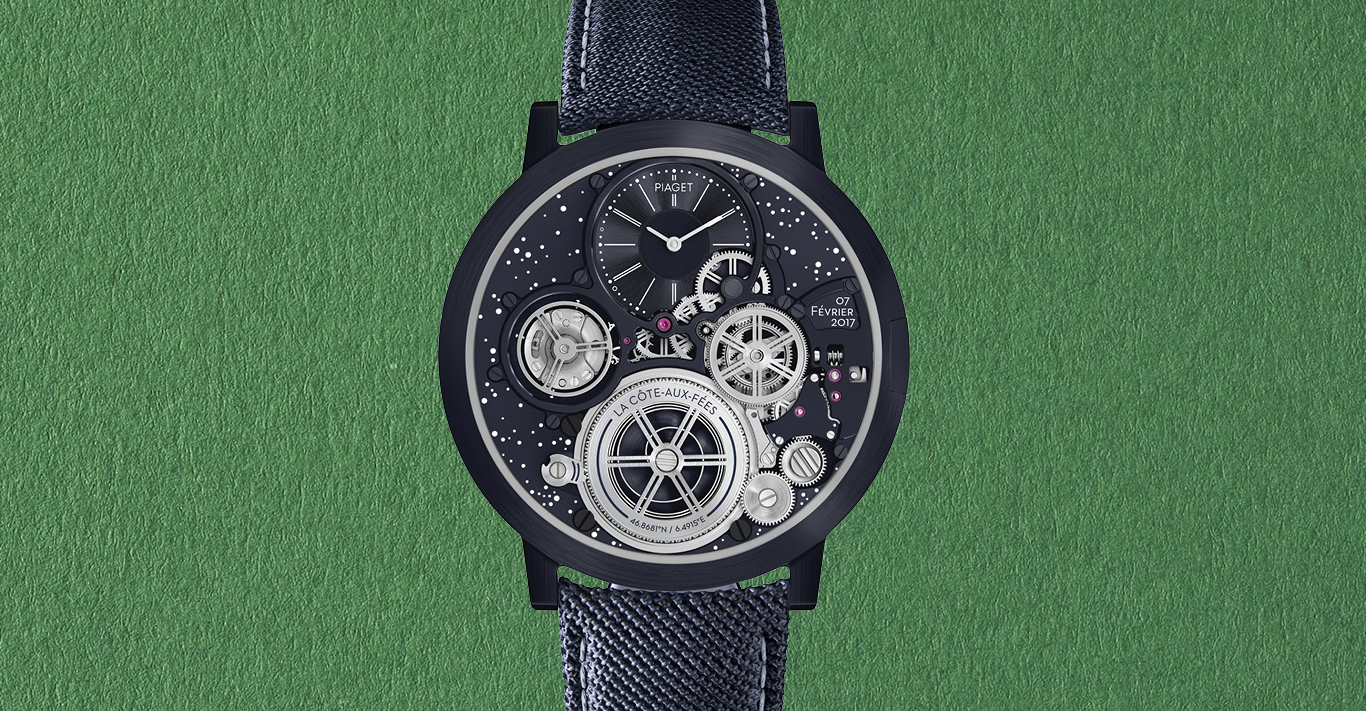
Piaget’s one-of-a-kind Altiplano Ultimate Concept pays tribute to its long legacy of ultra-thin timepieces
Piaget’s pedigree in ultra-thin timepieces stretches back centuries, a tradition that it continues to this day in the pursuit of ever-more technical miniature wonders. The company’s founder, Georges-Edouard Piaget, supplied watch brands with its ultra-thin watch components as early as 1874, an expertise that it applied with great skill and success to its following creations. In 1957, it introduced the world’s thinnest mechanical movement, the Calibre 9P, measuring just 2mm in height. This kick-started a streak of record-breaking movements, including the 12P in 1960, the 1200P and the 1208P in 2010.
The Altiplano Ultimate Concept (AUC) is among the most special expressions of this complex watchmaking. Four years in the making, this exceptionally thin watch was first brought to life on 7 February 2017 at 07:47am. In April 2020, the first model left Piaget’s workshops to be appreciated in the real world. Now it returns with a one-off piece that pays tribute to its journey.
Micro-engineering on this (tiny) scale requires a complete reworking of how watches are traditionally composed. A classic example would be made up of four layers: the bezel and crystal, the dial and hands, the movement and the caseback. Here these are fused into an innovative construction that makes each element as compact as possible. This involves the bridges, dial and hands being placed on one side, with the caseback, movement, mainplate and bezel on the other. In total, it comes in at just 2mm in height.
The dial itself is just as spectacular. The maison has chosen a historic font for the logo – the same featured above its manufacture in La Côte-aux-Fées, Switzerland. The time it took its first beat is marked with two enlarged dots on the minute rings, while its birthday is inscribed in a small window at 2 o’clock. In a whimsical finishing detail, the alluring constellation pattern that adorns it replicates the stars above La Côte-aux-Fées at the exact date and time of the AUC’s birth.
