



Richard Mille’s passion for material alchemy and rigorous testing makes its high-octane timepieces fit to handle the fray
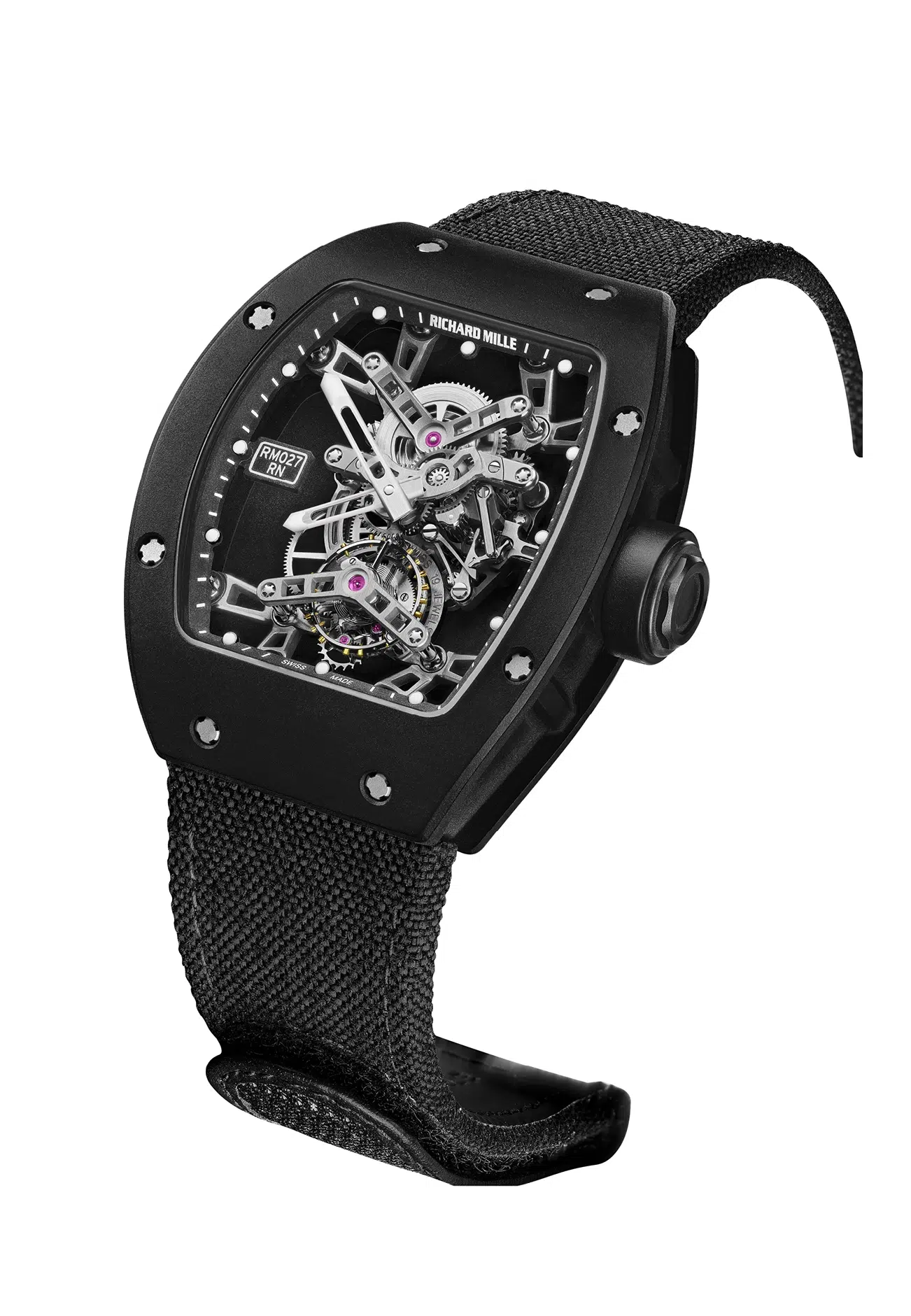
Richard Mille RM 027 'Rafael Nadal' Tourbillon
Established in 2001 and based in Les Breuleux, Switzerland, Richard Mille is one of the most experimental maisons, consistently pushing the boundaries of modern horology with patented materials and movement technologies. This future-facing approach has seen its timepieces land on the wrists of the world’s leading polo and tennis players, including Pablo MacDonough and Rafael Nadal.
For the eponymous founder of the house, it was always a dream for athletes to wear his timepieces during competition. ‘Richard Mille has always wanted sportsmen and women to be able to wear a watch while playing their sport,’ explains technical director for movements at Richard Mille, Salvador Arbona.
It was the conception and design of Nadal’s RM 027 Tourbillon watch, which the tennis pro debuted during his 2010 victory at Roland Garros, that cemented the maison’s reputation for highly technical sports watches built to withstand the rough and tumble of the game.
We were moving into the field of ultra-sportswear with a very high-level, high-performance player. It changed everything,’ explains Arbona. Finding out who the watch was destined for created a flurry of excitement and raised a lot of technical challenges. ‘Will a tourbillon calibre be able to withstand his ultra-powerful shots and long matches? How can we make it more robust? How can we prevent the watch rubbing with his two-handed backhand?’ he recalls.
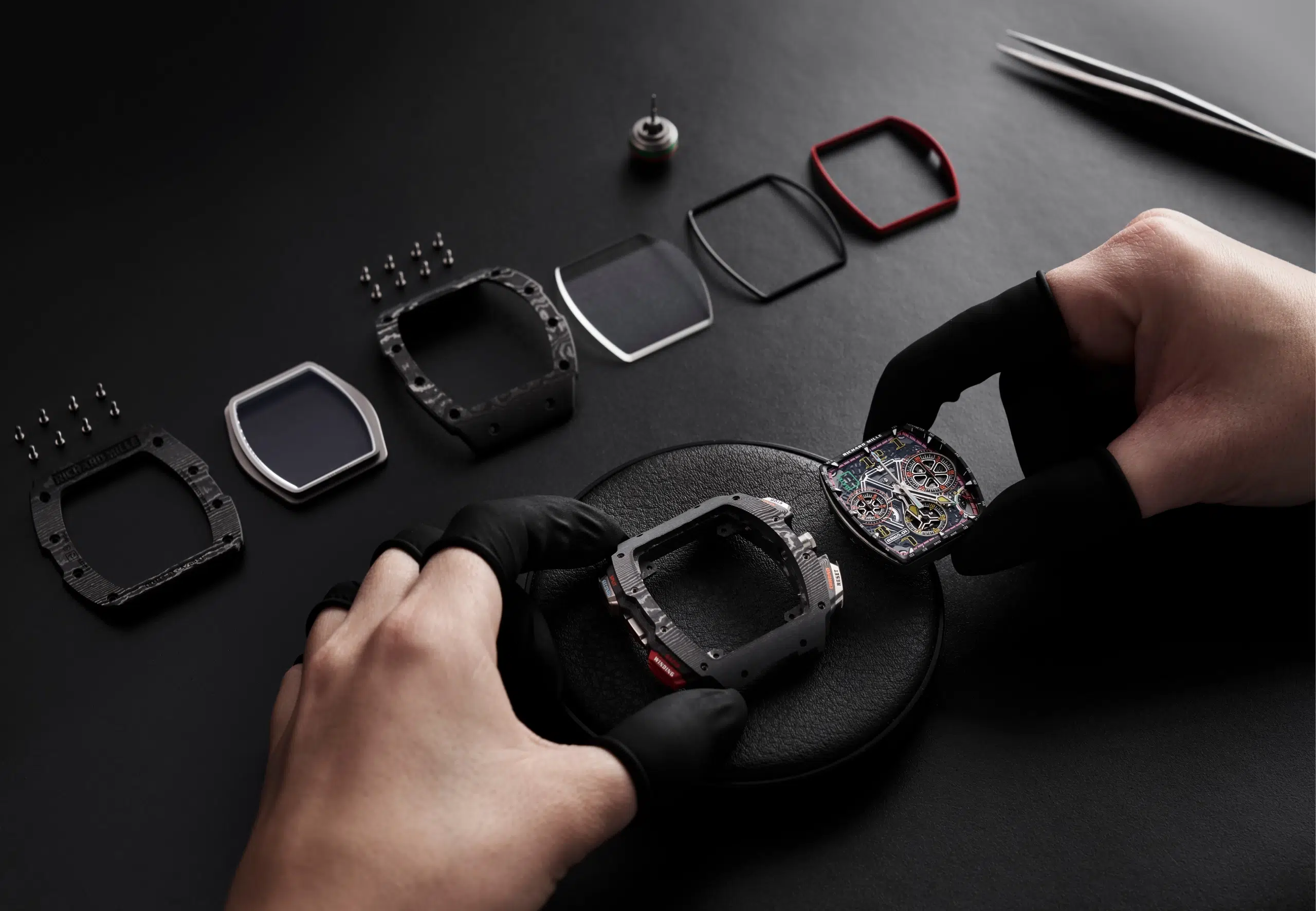
As well as developing novel technologies, such as suspended movements for increased shock protection, one of the corner stones of the brand is its alchemic material development, with the fields of aerospace, automotive racing and composite engineering providing creative inspiration.
The brand’s Carbon TPT®, for example, is made from ultra-thin carbon sheets slimmer than a human hair. It makes a case that’s virtually weightless on the wrist, but 25 per cent stronger and 200 percent more resistant to micro-cracks than regular carbon composite, and its latest iteration of this material is 15 per cent more rigid than the original. The brand has also concocted Gold Carbon TPT® an Gold Quartz TPT®, which blends in gold leaf for that glossy look, minus the heavy burden of standard gold.

Richard Mille’s intense testing methods are also the proof in the pudding when it comes to performance. Both materials and movements undergo years of lab tests under extreme conditions to put its creations through their paces. Movements are subjected to an ageing test in a winding machine to simulate 10 years of wear, while a pendulum shock test uses a weighted hammer dropped on the watch at various points on the dial, alongside 24 hours of shaking the movements in a machine that creates 144,000 small shocks.
Perhaps the most noteworthy in the brand’s appraisal methods is the “Nadal test”, which exposes the watch to intense G-forces. Developed in 2010 to put the first RM 027 Rafael Nadal through its paces, the test suspends the watch head in a machine where it is exposed to G-forces in excess of 800G, then tested further in a specialist facility at up to 15,000G.
For perspective, the human body can handle 6G before potential fatality occurs. In total, there are an average of 120 different tests that a new Richard Mille model is subjected to before it is given the green light for production. While this level of engineering is beyond what most mere mortals need to do battle with in daily life, you’ll at least have the novelty of having a watch on your wrist that might just survive a speeding bullet. Whether you will is another matter.
POA; richardmille.com
