


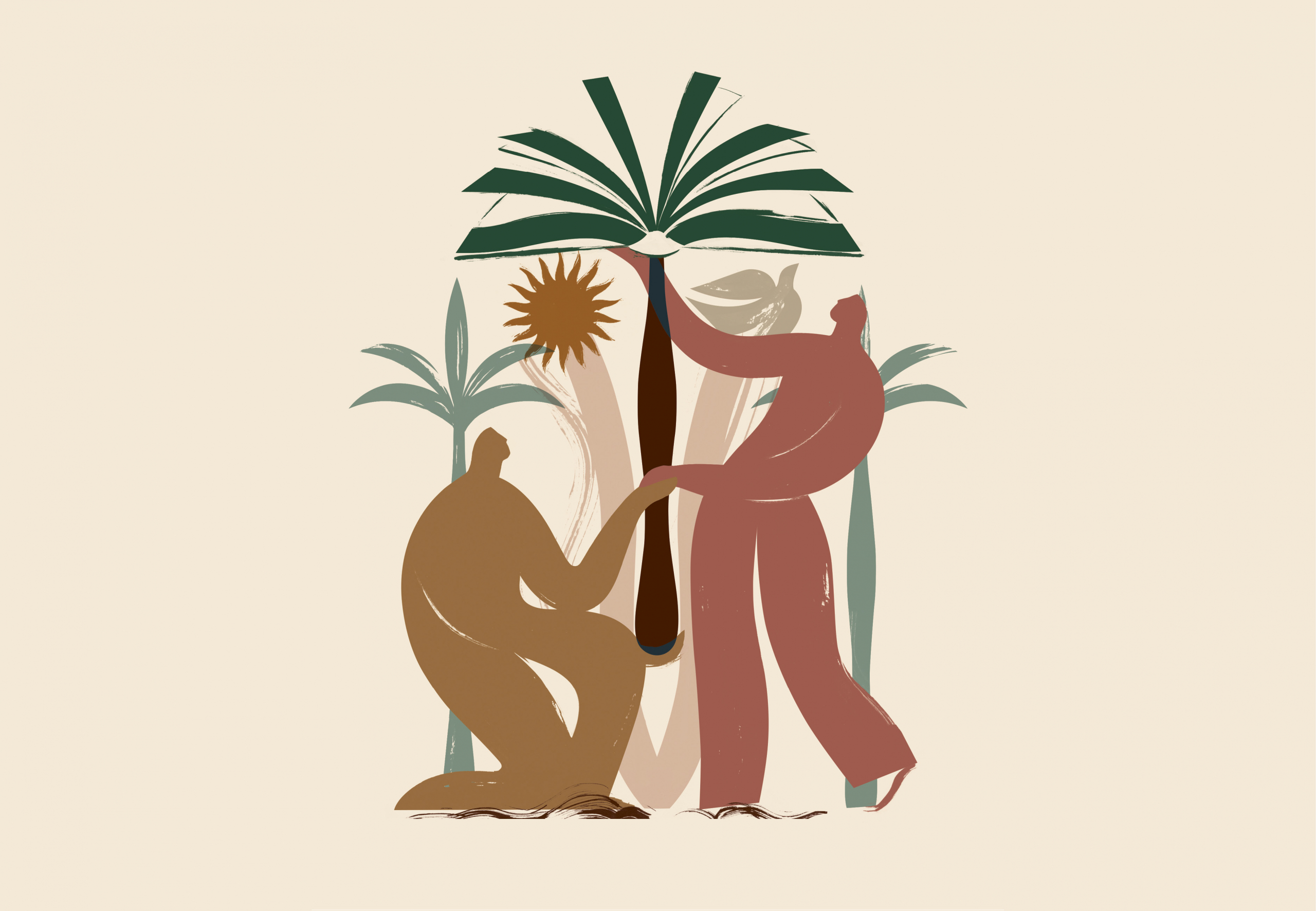
Abdulla Galadari, a Muslim professor at Abu Dhabi’s Khalifa University, and Rick Sopher, a Jewish banker, have co-authored a book that pushes for interfaith peace
On a hot July day this year, a scholarly international crowd gathered at London’s Aga Khan Centre to listen to What the Qur’an really says about Jews, Judaism and the Bible, a much-anticipated presentation, particularly with the war in Gaza showing little signs of abating at that time. It was delivered by Abdulla Galadari, a Muslim professor at Abu Dhabi’s Khalifa University, and Rick Sopher, a Jewish banker.
Rick Sopher is CEO of Edmond de Rothschild Capital Holdings, where he’s worked for the last 32 years. I’ve known him since we were at Cambridge University, and recently he showed me a video of his trip to Saudi Arabia, when he took a group of Muslims, Jews and Christians to plant palm trees in Medina as symbols of friendship and reconciliation. I asked what had prompted him to pursue this mission.
‘Although I have no documented proof, our family, as Iraqi Jews, lived happily in Babylon, now Baghdad, for the past 2,500 years, 1,300 of those years under Muslim rule,’ Rick explains. ‘But around the 1930s everything changed and there was a mass evacuation of Jews. The last of my family fled by donkey in 1971, and today there are hardly any Jews living in Muslim countries. About 10 years ago, I started wondering why. I decided to learn Arabic, which my ancestors had spoken.’
Rick hired a teacher who came every weekend, bringing books to translate. ‘One day I said, “These books are a bit dull and banal, so why don’t we translate this into Arabic?” I picked up my Torah, the Hebrew Bible, and off we went. It was extraordinarily exciting to discover how aligned the Hebrew and Arabic language were.’ He was also struck by how many characters in the Qur’an were familiar from the Bible: Abraham, Isaac, Ishmael, Moses and Aaron, and the Children of Israel: ‘Extraordinarily, the Qur’an mentions Moses 136 times and Muhammed only four or five. I was suddenly seeing the Bible in a whole new light.’
Rick realised that many well-known Bible stories, like Jonah and the Whale, were narrated in the Qur’an with the assumption that the reader would already know the story because it was common cultural knowledge. He became increasingly astonished at how the stories in both seemed so aligned, albeit with intriguing differences, and wanted to check his findings.
He persuaded the Cambridge-based Woolf Institute to allow him to convene a reading group of the world’s top religious professors: ‘It was Covid so the professors, who came from far and wide, had time to Zoom. We all began exploring the subject and interesting concepts emerged – for example, we found that the Qur’an is sometimes talking about a Christian interpretation of the Bible rather than the Bible text itself.’
Rick decided to write a book, comparing the Bible and Qur’an in a new way by looking at how the Qur’an might relate to each of the 54 portions of the Torah that are read in synagogues on a weekly basis. Abdulla Galadari was an early participant in Rick’s online forum, and Rick now invited him to be his co-author. ‘The book’s being published by the Jewish Publication Society, the biggest publisher of Hebrew Bibles in America,’ says Rick.
Rick has initiated or participated in several important interfaith dialogues, like the Drumlanrig Accords signed earlier this year by six senior Muslim leaders, including Imams, and six Rabbis, all from different strands of their religions. ‘We sat down at Drumlanrig Castle, hosted by the Duke of Buccleuch, and there was no disagreement or tension on religious or scriptural grounds,’ says Rick. ‘We made great progress to encourage respect between followers of each religion and to try and stop the tension in the Middle East taking root too strongly in the UK.’ The Accords were signed at a ceremony in Spencer House and then the signatories were received by King Charles at Buckingham Palace. Even with this royal stamp of approval, Rick realised this was just the start of a journey to improve interfaith relations.
At the Aga Khan Centre, Rick and Abdulla shared the stage and laid out how the Qur’an, far from being negative about the Bible, contained some beautiful words for it. Afterwards, questions were robustly challenging but ultimately the audience was delighted to see a Jew and a Muslim united in a genuine attempt to push for interfaith understanding. ‘The point of all this, for me, is to use the scriptures as a basis for togetherness and respect and absolutely not as a basis for inciting violence and terror,’ concludes Rick. Hugely ambitious though his vision is, he is already well on the way to attracting the attention of key international figures seeking new ways to broker peace.
Illuminating Scriptural Connections: A Qur’anic Commentary on the Torah by Rick Sopher and Abdulla Galadari will be published later this year.
Rick’s next talk will be at JW3 on Finchley Road, NW3 6ET on 3 February; jw3.org.uk
