


A deep dive into Omega’s reimagined Seamaster Planet Ocean
Twenty years after the first Seamaster Planet Ocean surfaced, Omega has returned to one of its most recognisable dive watches with a redesign. This anniversary marks the debut of the fourth-generation Planet Ocean – a model that remains faithful to the spirit of the original, yet reimagines almost every element, from the case to the bracelet, for a more streamlined appearance.
The Planet Ocean occupies a distinctive space in the Swiss watchmaker’s lineup. Less ubiquitous than the Speedmaster and less traditional than the Seamaster Diver, it has always represented the brand’s more technical, performance-led side.
To understand the Planet Ocean’s place in the brand’s collection, it helps to look back at the Seamaster’s story, which began in 1948. The professional diver’s design language took shape in 1957 with the Seamaster 300 – the blueprint for the Planet Ocean’s silhouette. Its lyre-lug case, bold arrow hands and robust proportions, seen on the 1960s military-issue Seamaster divers, later inspired the Planet Ocean when it debuted in 2005.
That first generation was conceived as a more “serious” diver: water-resistant to 600m and powered by the co-axial calibre 2500, it introduced the now-iconic combination of black or orange bezels and broad-arrow hands. The orange bezel, in particular, became a signature – a striking alternative to the standard black-and-steel diver aesthetic. Later generations brought ceramic bezels and slimmer, more integrated designs, gradually evolving the Planet Ocean from a tool watch into one of Omega’s most recognisable divers.

Seamaster Planet Ocean 600M with orange rubber strap, £7,500

This latest release introduces seven co-axial Master Chronometer models, including versions in that vivid orange hue. Each measures 42mm, the same as the 2005 original, but the profile is noticeably slimmer than its predecessor. The case now features a two-part structure, combining the main body with an inner titanium ring for added strength and reduced weight. The helium escape valve has been removed for a cleaner silhouette, while a flat sapphire crystal contributes to the refined, compact proportions. Despite the sleeker profile, water resistance remains an impressive 600m. Beyond the case, the sharper lines and angular facets take inspiration from Seamaster models of the 1980s and ’90s.
The new bracelet design – with flatter links, brushed outer rows and a polished centre – offers a neater, more integrated fit that complements the watch’s updated appearance. Each matt-black dial retains the Planet Ocean’s signature arrowhead hands and bold hour markers, while the Arabic numerals have been reworked in a more open, squared typography that nods to the first-generation model. And creating an uncluttered dial, the date aperture has been removed.
Options include three versions with orange ceramic bezels, two with blue, and two all-black designs with rhodium-plated numerals. The diving scale is rendered in white enamel on the blue and black models, and in white hybrid ceramic on the orange versions, depending on the colourway. The titanium caseback, engraved with the Seamaster and Planet Ocean names, replaces the sapphire window.

Seamaster Planet Ocean 600M with black rubber strap, £7,200
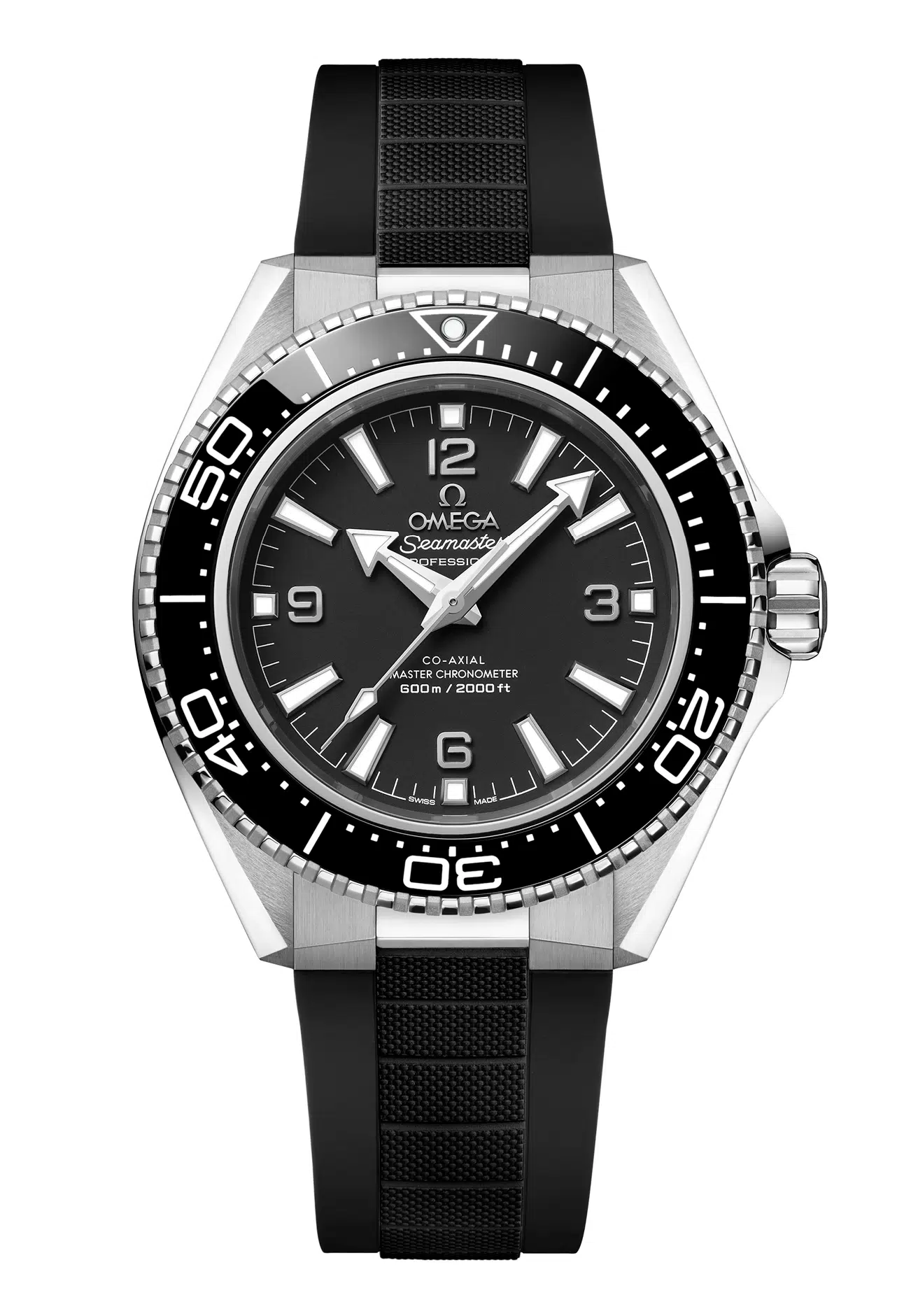
Inside, the watches are powered by the co-axial Master Chronometer calibre 8912 – the same movement used in the Ultra Deep, Omega’s 6,000m professional dive watch – offering an impressive 60 hours of power reserve. The bright orange ceramic, long a hallmark of the collection, showcases Omega’s latest ceramic craftsmanship to achieve a vivid, uniform tone.
To coincide with the latest Planet Ocean launch, Omega has chosen British screen and stage actor Aaron Taylor-Johnson to front the campaign – a natural pairing, with both the watch and its ambassador projecting a quiet confidence.
Blue and black models, £7,200 with rubber strap, £7,700 with steel bracelet; orange model, £7,400 with rubber strap, £8,000 with steel bracelet; omegawatches.com
