Ahead of a new exhibition opening this summer, Brummell explores the life and work of Enid Marx
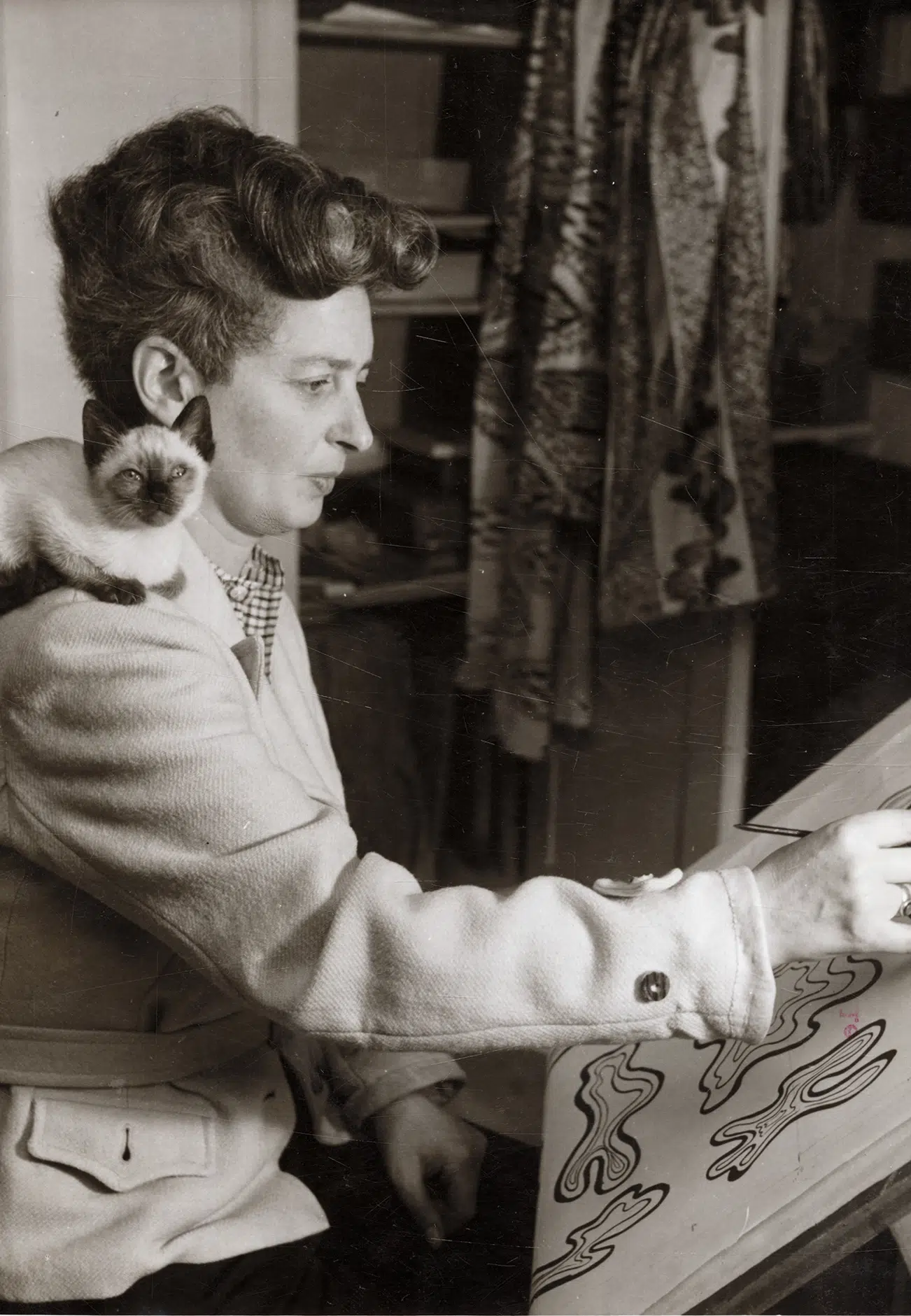
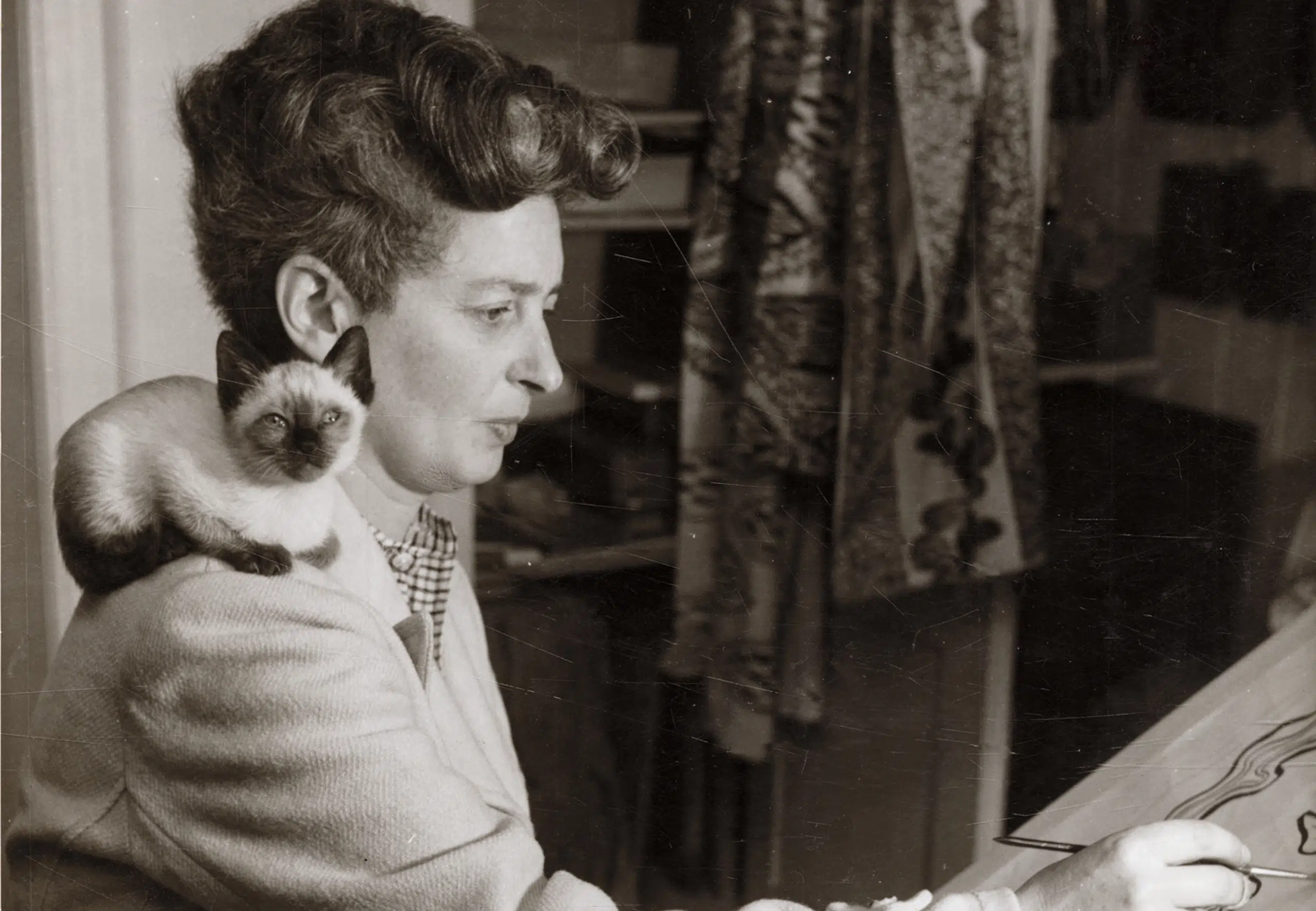
Enid Marx at work in the studio, overseen by one of her cats, 1948; moquette tube fabric
Forget Picasso. In the post-war years, more people would have seen, and known about, the work of Enid Marx. Now almost forgotten – there are those who regard her as the most famous designer people have never heard of – Marx was obsessed with patterns. She was responsible for designing the moquette (French for carpet) for London Transport, not for floors of course, but as upholstery for the seats on the tube.
On top of that, in 1952, Marx came up with the design for postage stamps for Queen Elizabeth II’s accession to the throne and created bold block-print textiles using natural dyes. This is just the tip of her legacy – something that Compton Verney Art Gallery in Warwickshire is exploring in an exhibition dedicated to the designer. It also holds the Enid Marx/Margaret Lambert Collection of Folk Art, much of which inspired Marx’s designs.
But back to upholstery… it’s hard to remember that the London Underground was
created with a vision. Like the Moscow Metro, whose stations were designed to be “Palaces for the People”, as Stalin put it, with marble walls and chandeliers, London Transport wanted to cocoon its travellers with luxury, although minus the sparkling crystal light fittings.
The stations were streamlined Modernist masterpieces built in the 1920s and ’30s by Charles Holden; the trains had wide padded seats, leather armrests, Art Deco uplighters and wooden floors. The man behind this vision, Frank Pick, the chief executive of London Transport, believed – well before Terence Conran – that good design made life worth living. In Frank Pick, Enid Marx had found a kindred spirit.
A distant relation to “Das Kapital” Karl, Marx – Marco to her friends – had much of her forebear’s vision, contrariness and persistence. A small, talkative live-wire, she kicked against her background – she was educated at the prestigious girls’ boarding school Roedean – and rather than go to finishing school in Switzerland, she went to Central School of Arts and Crafts and the non to the Royal College of Art. There, she met lifelong friends Edward Bawden, Eric Ravilious and Barbara Hepworth – and Paul Nash, a tutor, then a tutor, who became one of her lifelong supporters.
She overcame the minor setback of failing her final diploma – her work was thought of as “vulgar” and “too abstract” – to champion what she called the ‘popular arts’ as a reaction to ‘the washed-out William Morris stuff’. Way ahead of her time, Marx started her own workshop over a cow shed in Hampstead, producing abstract and geometric patterned textiles, using natural dyes rather than chemicals. Soon she had a starry list of clients including Gerald du Maurier, the actor-manager and father of Daphne, and Noël Coward’s muse, Gertrude Lawrence.
Marx’s big breakthrough was just before the war when she was asked by the legendary Pick to design seating fabrics. In her clipped cut-glass voice, immortalised in a link on TfL’s website, she describes how Pick’s sidekick, Christian Barman, had told her that ‘seating had to look fresh at all times, even after bricklayers had sat on it’. Also, florals – which had been all-pervasive, particularly on the Metropolitan line – were out. The result was the iconic “Shield” design that had been inspired by artefacts from the British Museum; with a colour combination of green, red and black, it worked well with the green leather armrests on the Bakerloo, Northern
and District lines.
As Az Crawford, the curator of the exhibition, points out, Marx belonged to a milieu of ‘gender non-conforming modern women’ who developed Modernist arts and crafts for a clientele of like-minded women. Marx herself met her life partner Margaret Lambert, a historian, in the 1930s. They were devoted to each other for the rest of their lives, although Marx resisted labels, perhaps through a fear of being ostracised by the institutions she worked for. As it was, she was fired from a government job during World War II for the crime of wasting resources after she asked for extra paper to doodle on.
One of Crawford’s discoveries in this fascinating exhibition is how Marx incorporated coded signals of gender non-conformity into her designs. A dress made for Lambert shown in the exhibition has an abstract motif based on a font cover from Spreyton Church of St Michael, in her partner’s home village in Devon. Another way she telegraphed her intertwined love for Lambert was through a motif that appears like a double helix. ‘Marx’s textiles show that the social and political cannot be separated from the personal when it comes to surface design,’ Crawford explains. ‘Her textiles make for a compelling exploration of interwar culture, art and design through the eyes of non-conforming women.
Enid Marx at Compton Verney Art Gallery is onfrom 18 July – 3 January 2027; WarwickshireCV35 9HZ; comptonverney.org.uk